





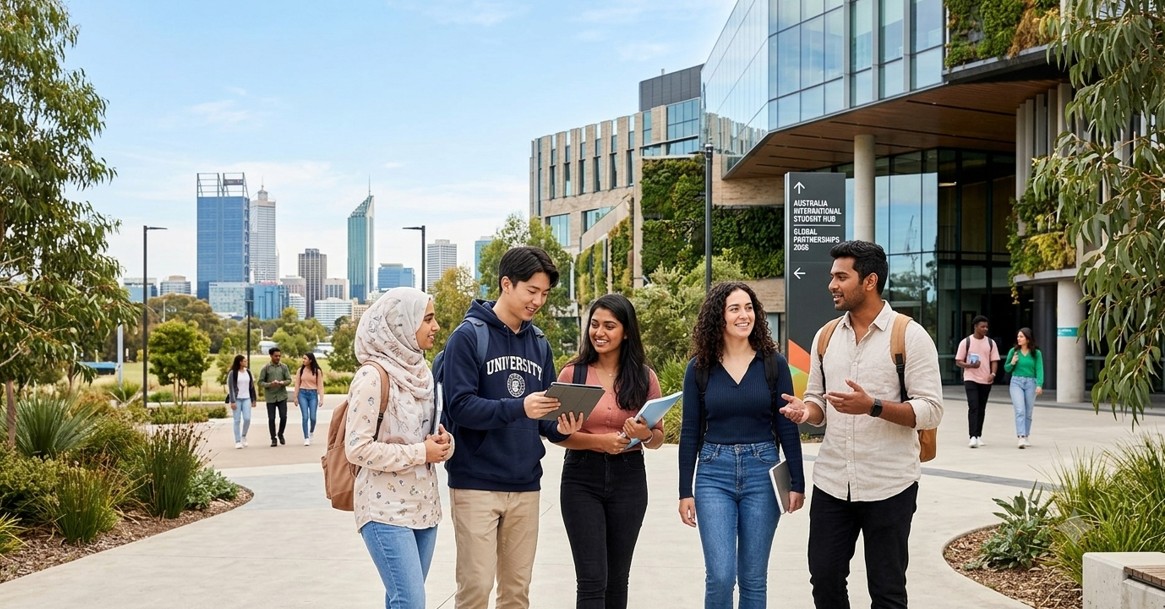
For over two decades, Australia’s international education sector operated on a predictable trajectory of rapid, un-capped expansion. Cosmopolitan lecture halls filled to capacity, inner-city rental markets tightened, and the student visa journey became a well-trodden path for global youth seeking a dual prize: a world-class degree and a gateway to Western employment. But the era of unchecked growth has officially come to a close.
Faced with mounting domestic pressure over urban housing shortages and system integrity, the Australian government has initiated what industry insiders are calling "The Great Reset." Through a sweeping matrix of strict enrollment caps, elevated financial barriers, and aggressive processing reshuffles, Canberra is fundamentally rewriting the rules of the game. For prospective students and global academic consultants, survival in this new landscape requires a total shift in strategy.
At the heart of this regulatory overhaul is the National Planning Level (NPL), a hard federal cap that restricts new international student commencements to 295,000 places. While the figure represents a managed 9% adjustment from previous transitional lows, the real story lies in how those places are being distributed. The new framework draws a clear line in the sand, heavily favoring public universities over private vocational colleges, while institutions that actively invest in and expand their own dedicated student accommodation infrastructure are being rewarded with higher allocations.
Crucially, the geopolitical tides are turning as institutional quotas are being strategically routed to diversify campus demographics, featuring a massive recruitment pivot toward Southeast Asian markets. For students from these target regions, the policy shift opens unprecedented doors; conversely, for over-represented traditional markets, competition for the remaining slots has reached a fever pitch.
Securing an institutional offer letter is no longer the highest hurdle, as the Department of Home Affairs has fortified the visa boundary line, aiming to ensure that every arriving student is both academically elite and financially self-sufficient. The minimum baseline for personal proof of funds has been raised to AUD 29,710 in accessible savings for a single applicant—a move designed to insulate students from immediate financial distress upon arrival. Simultaneously, the English language benchmark has been tightened, pushing the minimum IELTS threshold for a standard Student Visa (Subclass 500) up to an overall score of 6.0. The message from Canberra is unmistakable: the student visa is strictly an educational mechanism, not a backdoor work permit.
Perhaps the most disruptive operational shift comes via Ministerial Direction 115, which has dismantled the traditional first-come, first-served visa processing queue. Applications are now triaged under a strict institutional risk-rating framework that fast-tracks public universities utilizing less than 80% of their allocated national cap through the system. This "Green Zone" priority has triggered an unexpected boom for high-quality regional universities, which are suddenly seeing visas approved in record time. On the other end of the spectrum, over-subscribed, elite metropolitan universities in Sydney and Melbourne find themselves in a "Red Zone," facing extended processing delays and microscopic document audits.
Simultaneously, the government has officially banned domestic "visa hopping" to close historical loopholes. Previously, thousands of applicants entered the country on tourist or graduate work visas and continuously transitioned to cheap vocational student visas to prolong their stay. Under the 2026 mandates, temporary residents can no longer transition to a student visa from within the country; they must return home and apply offshore, subject to full regulatory scrutiny.
For ambitious graduates aiming to leverage their Australian degrees into global corporate careers, the Post-Study Work Visa (Subclass 485) has also undergone a dramatic tightening. In a sweeping demographic shift, the maximum age limit to apply for a post-study work visa has plummeted from 50 to 35 years of age, effectively altering the calculus for mature-aged MBA and PhD candidates. Furthermore, visa lifespans have been standardized to a strict 2 years for Bachelor’s and Master’s by coursework degrees. However, the policy contains a deliberate golden carrot: students who choose to look beyond the crowded skylines of Sydney, Melbourne, and Brisbane and instead graduate from designated regional campuses remain eligible for lucrative 1- to 2-year post-study extensions.
Ultimately, Australia’s international education system remains one of the most prestigious, high-yielding investments a student can make. The underlying fundamentals—nine universities in the global Top 100, a robust economy, and the highest minimum wage in the developed world—have not changed. However, the window for casual, last-minute applications has permanently closed. The successful applicant of 2026 is a strategist who applies 4 to 6 months in advance, looks past the immediate gravitational pull of Sydney or Melbourne, targets high-growth sectors like digital tech and healthcare, and aligns themselves with high-priority regional institutions. Australia is still open for business—but it is only accepting those who are prepared to play by the new rules.